Samandal - Salamander
"Much like the dual habitats of amphibious creatures, Samandal comics thrive between two worlds; the image and the word, entertainment and substance, the low brow and the raised brow, the experimental and the traditional."
Contexualizing Lebanon - Samandal is located in Lebanon
Samandal: Censorship case and Implications
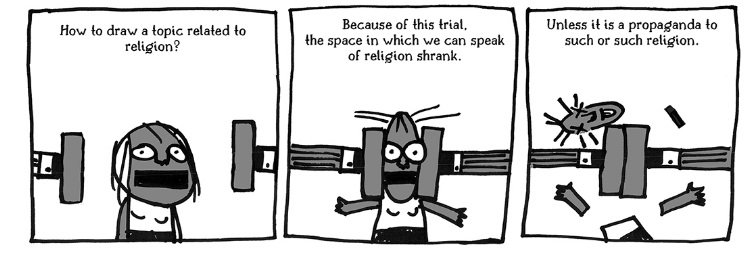
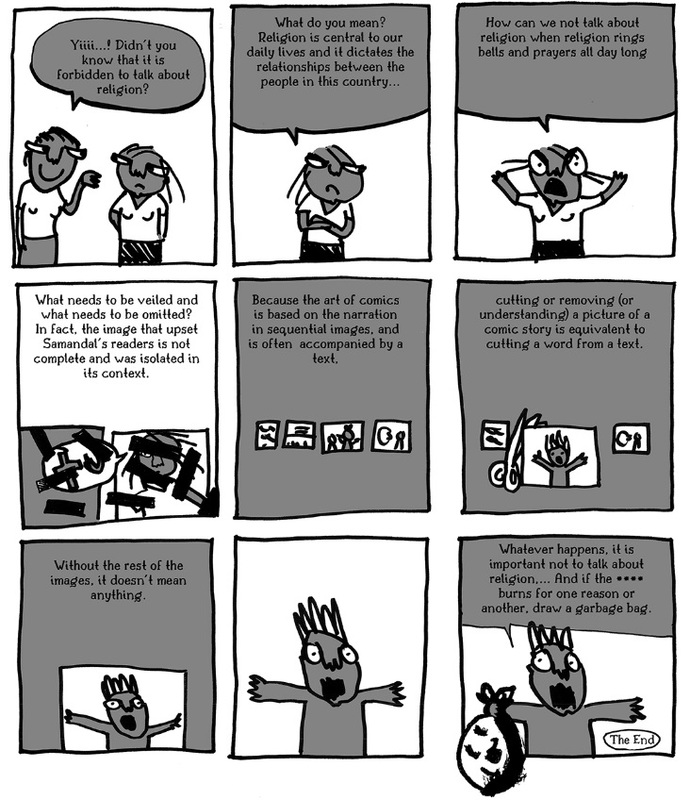
The lives of the Lebanese ties with the country. Looking at Lebanese history, it is clear that they have had a long history of civil war. The Lebanese government has been influence by religion since France colonized and gave them back their independence. Lebanan is still feeling the reprecussion of French colonization. Some Lebanese take to comics to express themselves, but just like with any speech or media, there are restrictions on what one could say. Censorship laws are in place so that anything that is seemingly against the government is silenced. One of those things is religion: especially Christianity. Samandal, an online venue for Arab comics in Beruit, Lebanon has recently announced that they had been fighting against a censorship and lawsuits against two specific panels placed in their 7th vol. Interestingly enough, the editors, not the artists themselves, were the target of the lawsuits. They were charged with a) inciting sectarian strife b) denigrating religion c) publishing false news and d) defamation and slander. Samandal responded in one of their interveiws that the lawsuit and censorship was a form of the governments way to suppress opposition against it. They point out that the growing popularity of the site had made it a target for their display of power. And that is what it comes down to: a display of power. TokTok, another online venue for Arab comics, has also seen growing popularity. One key feature that each venue boasts about is its accessibility to the people: not only can the people easily access these venues, but they can just as easily submit their own works to be published within these venues. This shows the values of connectedness, community, and the value of expressing oneself within their oppressive society. The venues innocently helps people express themselves through comics, but Samandal made the mistake of expressing themselves, when clearly the Lebanonese government opposes such expression if it is against it's ideas.
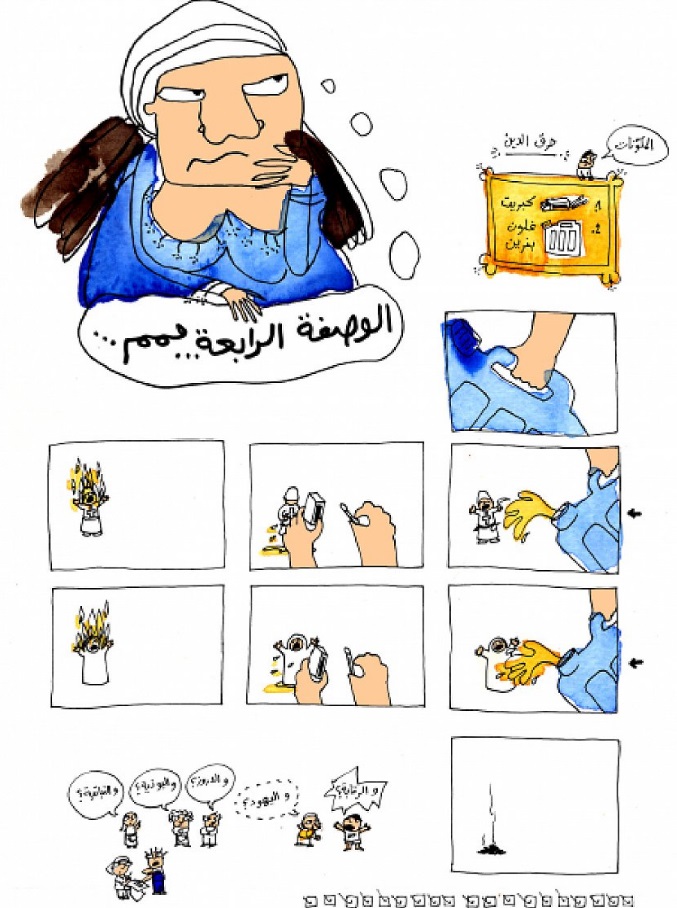
These were the panels that got Samandal charged with a) inciting sectarian strife b) denigrating religion c) publishing false news and d) defamation and slander.
|
The two panels that shows a Christain on fire, and a Muslim on fire, are the panels that were subject to the lawsuit against the editors of Samandal. Samandal is ". . . is an amphibian, living between the sea and the earth, in the same way that comic books are an art form that is between words and images. We (the founders of Samandal) want our comic to combine experimental and traditional aspects, both high culture and popular culture," said Lena Merhej The comic is called "A Lebanese Recipe for Revenge." The creator, Lena Merhaj, states in regards to the lawsuit that "In terms of censorship, I will only speak to myself and say, I will not be silenced or encumbered by injustice." |
TokTok - Rickshaw
"Tok Tok is more preoccupied with the country’s social issues than with the politicians of the day. Its narratives range from wordless strips on corrupt government officials and businessmen, to the misadventures of an antihero combating sexual harassment."
TokTok centralizes around Cairo, Egypt
|
|
It is relatively difficult to find information on TokTok without knowing Arabic, but there is hope; soon, their works will be available in the Silicon Valley. TokTok's mission is to carry diverse ideas and backgrounds in order to show how everyone is making their own journey. Like Samandal, they invite anyone to participate in creating comics that may be shown in their next publication. TokTok was established Jan 1st, 2011, in the midst of Egyptian's uprising against the current state of political power. The date of establishment of TokTok is uncanny. TokTok was created in response to the events leading to the Tahrir Square uprising. At this moment in time, freedom of expression was limited, but the people of Cairo saw a hole: cartooning. Cartoonists in Cairo understand the value of the medium because it was a medium for the people, by the people. Since the uprising in 2011, there have been many accounts of journalism and activism being oppressed/ censored by the government, but comix have been overlooked. TokTok takes advantage of expression, and expresses those things you won't see in Egyptian media: social issues. We can see these ideas by looking at the available issue on TokTok's website. Although I cannot translate the language, we can still look at the images which hints at the concerns and ideals that go along with the people of Cairo. The magazine depicts the gritty life styles that has become the norm of Cairo residents. We can see the lives of the people of Cairo, giving us an insight towards the effects their State has had on them. Their style assures the reader that you can connect to the residents of the Cairo, while also understanding the effects the government and the political has had on them.
|
|
"Mohammed Andeel, one of the magazine’s five co-founders, who goes only by his last name in the tradition of Egyptian cartoonists, calls Tok Tok 'an answer to censorship.'" |